`planner`
(Principal Architect)Inspects existing routes, models, database schemas, and specifications to produce a concrete, step-by-step implementation blueprint before any code is written.
Transform your codebase into a deterministic, multi-agent software factory. Enforce strict architectural boundaries, 100% test coverage, and hard quality gates across 20+ programming languages.

While developers leverage AI daily for snippet generation, software engineering teams face severe systemic bottlenecks that threaten codebase integrity:
AI assistants freely mix concerns, bypass domain boundaries, introduce circular dependencies, and ignore core framework conventions.
Standard AI models generate superficial mock tests that assert trivialities while failing to achieve true 100% test coverage or simulate hostile edge cases.
Senior architects spend excessive time auditing, refactoring, and fixing sub-standard AI code rather than designing core high-value platform features.
Metacode Agentic Engine solves this by replacing ad-hoc prompt engineering with a rigid, multi-agent pipeline and automated deterministic quality gates that verify every single line of code against mathematical proof standards.
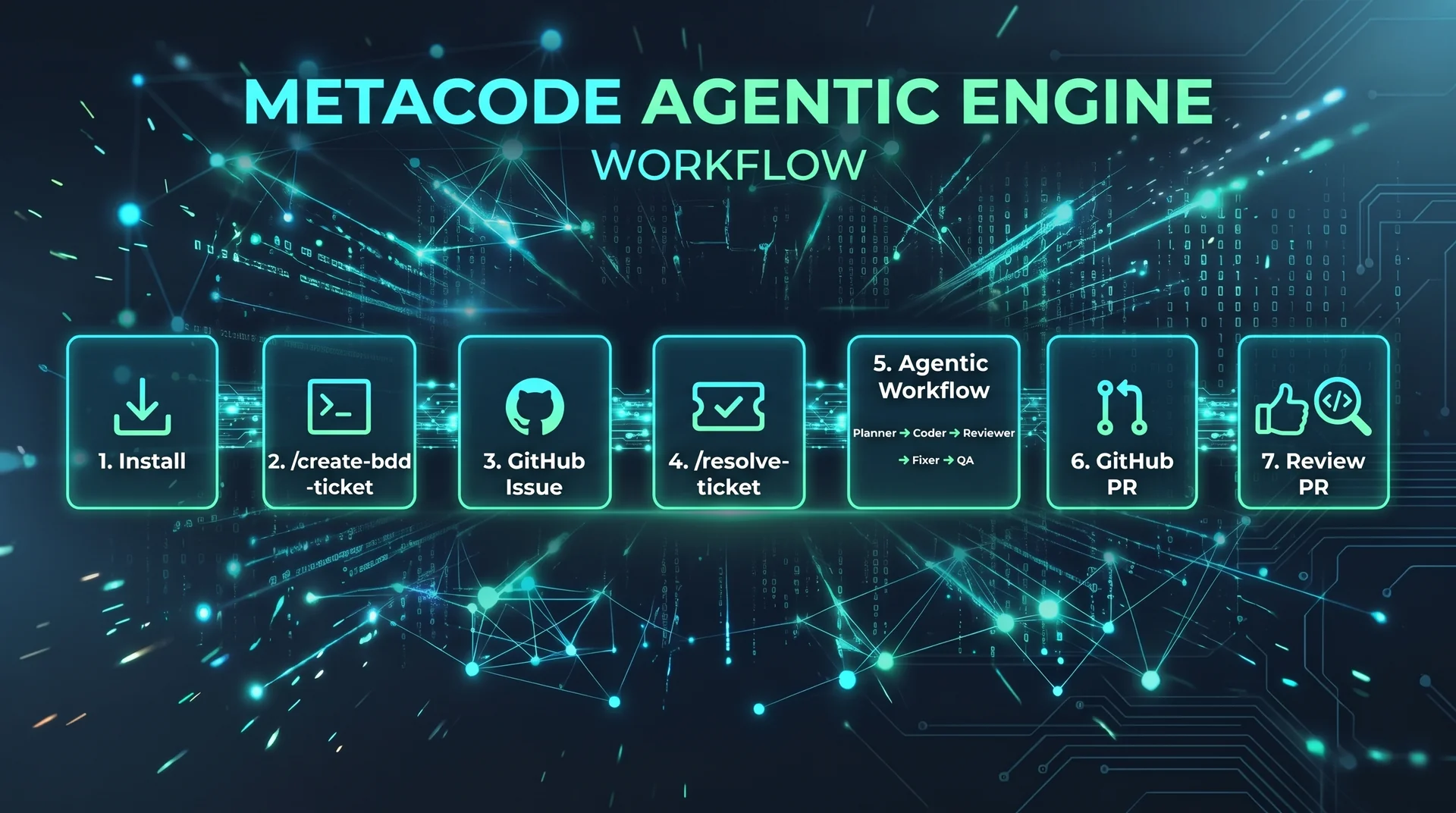
The engine provisions a secure, gitignored .agents/ environment inside your target repository, orchestrating five specialized subagents through a hard termination gate:

Inspects existing routes, models, database schemas, and specifications to produce a concrete, step-by-step implementation blueprint before any code is written.
Implements features strictly via Test-Driven Development—authoring failing test suites first, making them pass, and running automated linters & formatters (Pint, Prettier, gofmt).
Audits git diff, static analysis (PHPStan Level 10, ESLint, golangci-lint), OWASP vulnerabilities, and architectural constraints. Outputs REVIEW_STATUS: APPROVED or CHANGES_REQUIRED.
Applies minimal, surgical code adjustments to resolve specific defects or violations flagged by the reviewer or QA engineer without destabilizing adjacent domains.
Executes complete test suites across test databases, audits rigorous coverage thresholds (e.g. 100% lines/branches), and verifies edge cases. Outputs QA_STATUS: PASSED or FAILED.
A hard Stop hook intercepts session termination. The agentic system is strictly blocked from concluding its turn or opening a Pull Request unless both REVIEW_STATUS: APPROVED and QA_STATUS: PASSED are mathematically confirmed in the transcript.
Engineered for seamless integration with Antigravity, Cursor, Claude Code, and standard IDE toolchains via standard Markdown (AGENTS.md) and Model Context Protocol (MCP).
Transforms unformatted notes, tickets, or user stories into a structured GitHub Issue containing Gherkin Given / When / Then scenarios (Happy Path, Validation Failure, Tenant Isolation) and an automated TDD checklist.
Checks out a dedicated feature branch, launches the 5-agent pipeline in sequence, enforces static analysis & test suites, and opens a fully verified, ready-to-merge GitHub Pull Request ('Closes #ID').
Lightweight fast-path workflow engineered for minor defects, dependency security patches, configuration tweaks, or typo fixes that bypasses extensive planning while enforcing full test verification.
Reviewer comments and PR change requests are ingested directly through the fixer subagent, making targeted improvements and re-running test suites without re-planning overhead.
The engine's language-agnostic core decouples orchestration from technology specifics, allowing instant deployment across modern ecosystems:
Not every codebase starts at 100% coverage and PHPStan Level 10. The Metacode Agentic Engine treats AGENTS.md as the single source of truth for quality policy.
You can begin with deliberately low thresholds — for example 5% overall coverage combined with a strict “dirty files only = 100% coverage” rule — and raise the gates incrementally as the project improves.
This progressive enforcement model lets teams adopt the full 5-agent pipeline on mature or even zero-test codebases without an all-or-nothing rewrite. Architecture boundaries, static analysis levels, and coverage targets remain fully configurable and version-controlled.
Quality gates live alongside your source code in Git. As legacy modules are refactored, teams simply bump the thresholds in pull requests — turning technical debt repayment into a quantifiable, automated ratchet.
Set a low global floor (e.g. 5% coverage) while strictly enforcing 100% coverage on modified/dirty files. Immediate containment of new technical debt.
Incrementally increase static analysis strictness (e.g., PHPStan Level 5 → Level 8 → Level 10) on critical core domains during ordinary feature delivery.
Attain mathematically proven reliability with zero-compromise static analysis, exhaustive edge-case integration tests, and automated PR gating.
Early internal measurements on real tickets show a clear pattern:
Average lines of code produced per ticket dropped by over 25%. Eliminates bloated hallucinated helper methods and boilerplate sprawl in favor of high signal density.
Throughput is intentionally not faster than unconstrained prompt-driven coding. The extra time is spent enforcing Test-Driven Development, adversarial review, coverage gates, and architectural constraints.
The result is less code, higher signal density, and significantly lower downstream technical debt. We prioritise deterministic quality over raw speed.
Generating 500 lines of brittle, unverified code in 3 minutes creates hours of debugging and technical debt for senior engineers. Generating 220 lines of mathematically proven, TDD-backed code in 20 minutes creates durable software that survives decades in production.
Running every agent on the most expensive frontier model is wasteful. The Metacode Agentic Engine supports per-agent model assignment.
Heavy reasoning tasks (Planner, Coder) can use Claude Opus when needed to synthesize complex domain specifications and architect failing TDD suites.
Linear or surgical roles — Fixer and QA — routinely run on Claude Sonnet or equivalent mid-tier models with rapid response times and optimal economics.
Specialized model configurations dedicated to diff audits, OWASP vulnerability scans, and strict static analysis rule enforcement.
This selective allocation, combined with the observed 25%+ reduction in generated code volume, materially lowers token consumption and cost per delivered feature without compromising the hard quality gates.
We offer turnkey onboarding combined with repository licensing so your team can master autonomous TDD development immediately.
IDEAL FOR: Development teams (3–8 developers) with existing automated test foundations.
IDEAL FOR: Software houses and scale-ups wanting an end-to-end autonomous engineering pipeline.
IDEAL FOR: Enterprises with complex multi-repo topologies and strict regulatory governance.
Ready to eliminate architectural debt and let your developers focus on high-level design while autonomous agents handle rigorous TDD execution?
Founder & Lead Software Architect